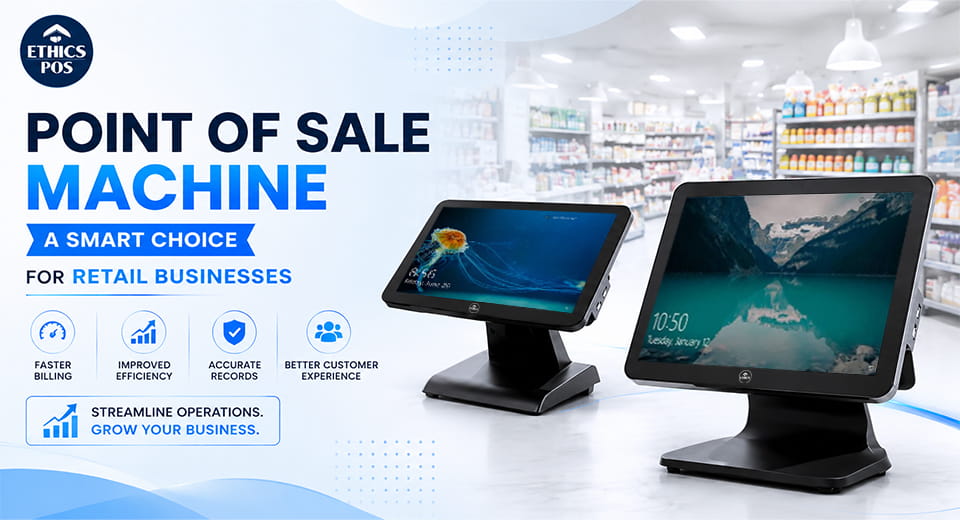
The retail market is getting competitive day by day; hence, businesses need speed, accuracy, and control. A point of sale machine helps manage billing, payments, and data from one system. Retailers, restaurants, warehouses, and service businesses now depend on modern POS technology to run daily operations smoothly.
This blog explains what a point of sale machine is, how it works, and why retailers invest in a POS machine. It also helps you understand how to choose the best POS machine for your business needs.
What Is a Point of Sale Machine?
A point of sale machine is a system that handles sales transactions at the checkout point. It records sales, processes payments, updates inventory, and generates reports in real time.
A modern point of sale terminal combines hardware and software. It replaces manual billing and reduces human errors. Businesses use POS machines in retail stores, restaurants, warehouses, pharmacies, and quick-commerce setups.
Key Components of a POS Machine
A standard POS system includes:
Display screen or touch panel
POS software
Receipt printer
Barcode scanner
Card and UPI payment support
Each component works together to create a fast and smooth billing process.
Why Retail Businesses Need a Point of Sale Machine
Retail firms operate in a price-sensitive and high-volume market. Manual billing slows down operations and affects customer experience. A point of sale machine solves these problems.
Businesses use POS systems to:
Speed up billing
Track sales accurately
Control inventory levels
Reduce dependency on manual work
A POS machine also helps businesses follow GST rules and maintain clear records.
Key Features of the Best POS Machine
The best POS machine supports business efficiency and scalability.
Fast billing and checkout
GST-ready invoicing
Real-time inventory tracking
Multiple payment options
Sales and performance reports
These features help businesses manage operations without complexity.
Benefits of a Point of Sale Machine for Businesses
Faster Billing and Operations
A point of sale machine speeds up the billing process and reduces waiting time. Faster transactions help businesses serve more customers in less time. This efficiency improves daily productivity and customer satisfaction.
Better Inventory Control
POS systems update inventory automatically after every sale. Businesses can track stock levels in real time and avoid overstocking or shortages. This control reduces losses and improves planning.
Accurate Sales Tracking
It records every transaction accurately. Business owners get clear visibility of daily, weekly, and monthly sales. This data helps teams track performance and identify trends.
Improved Business Decisions
POS reports help managers understand sales patterns and product performance. Businesses can plan pricing, promotions, and stock based on real data. This approach reduces guesswork and improves results.
Reduced Manual Errors
POS machines eliminate manual price entry and calculation mistakes. Automated billing ensures accuracy in invoices and tax calculations. This reliability builds trust with customers and partners.
Simplify Sales Process
The biggest advantage of the point of sale is that it can increase operational efficiency by accelerating transaction times and eliminating errors without involving employees. A built-in barcode scanner helps speed up purchase transactions and doesn't make customers stand in a queue. This will enhance their checkout experiences.
The system is equipped with multiple payment options, which allow customers to make payments in their currencies.
Conclusion
A point of sale machine plays a critical role in modern business operations. It improves speed, accuracy, and control across sales and inventory. The best POS machine helps retail sectors grow with confidence and efficiency.
If you want better operations, cleaner data, and faster billing, you should invest in a reliable point of sale terminal designed for your business needs.